
BIORESONANCE / BICOM
Another way of listening to the individual patient.
Bioresonance gives us another way to consider the individual patient.
At VitalWell, we use BICOM technology alongside the history, physical examination, conventional diagnostics, owner observations, and the overall clinical picture.
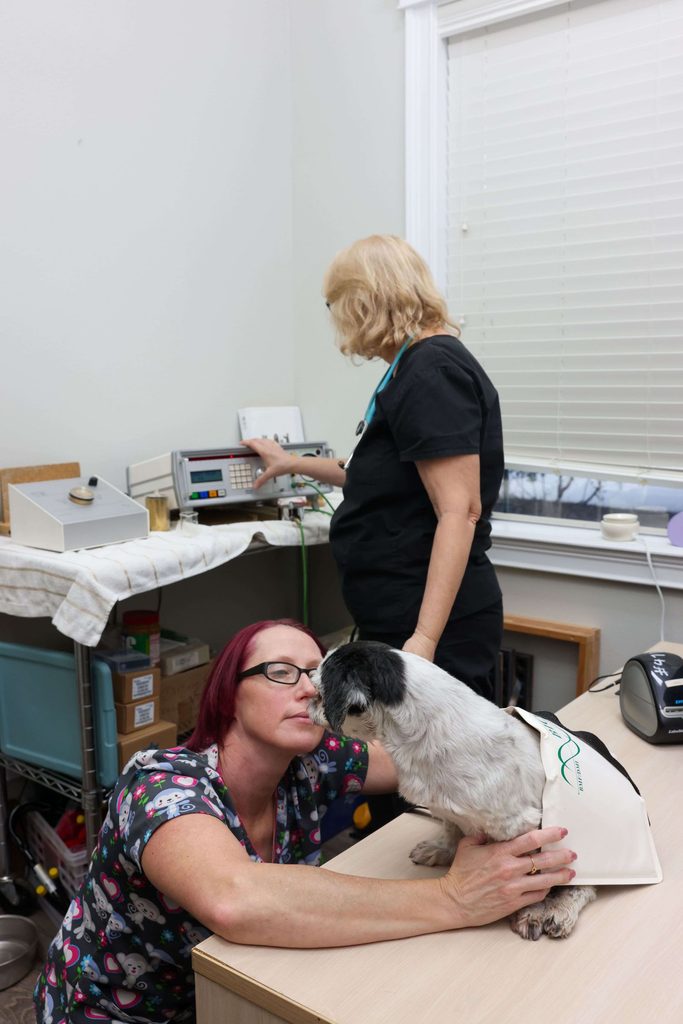
THE BODY GIVES US INFORMATION IN DIFFERENT WAYS
History tells us something.
The physical examination tells us something.
Laboratory testing tells us something.
Imaging tells us something.
And sometimes, we choose another way of listening.
Each of these tools reveals something different. Bioresonance adds information viewed through the lens of frequency and quantum medicine.
WHAT IS BIORESONANCE?
Bioresonance is a form of frequency-based or quantum medicine that uses frequencies as a way of interacting with biological information.
At VitalWell, BICOM gives us a way to explore those frequency-based patterns within the larger clinical picture.
Rather than measuring substances or disease markers in the way a blood test or other conventional diagnostic does, BICOM allows us to explore patterns of frequency response that may add another layer of information to the clinical picture.
We interpret that information in context—with the patient’s history, physical examination, laboratory testing, imaging when appropriate, the pet parent’s observations, and our veterinary judgment.
Different tools ask different questions.
The goal is not to replace one with another.
It is to understand the individual patient more completely.
THERE IS MORE THAN ONE WAY TO LISTEN
The body communicates in remarkably complex ways.
Chemistry is part of that communication. So are nerves, hormones, electrical activity and other biological signals.
Bioresonance approaches the patient through the lens of frequency and quantum medicine—looking for patterns that may help us decide where to investigate, what to support, and how to prioritize the next step.
It is another layer of information, not a replacement for the others.
Listening for patterns. Looking at the whole patient.

LISTENING FOR PATTERNS
A BICOM assessment begins by looking at the patient’s overall pattern.
We first consider the patient’s energetic state—whether the system appears depleted, low, balanced, or heightened.
From there, the assessment may explore patterns associated with different biological stressors or areas of concern, followed by the organ systems that may need support and potential “blocks” that could influence how the patient is approached.
The purpose isn’t to collect the longest possible list of findings.
It is to begin understanding what may matter most for this individual patient.
FROM THE BIG PICTURE TO THE NEXT PRIORITY
Sometimes an assessment gives us several pieces of information at once.
That doesn’t mean we try to address everything at once.
We review the overall pattern, consider what fits the patient clinically, and determine what should be prioritized first.
That may mean supporting particular organ systems, addressing an area of concern, or working through something that appears to be interfering with the body’s ability to respond appropriately.
Complex cases may therefore involve a series of individualized BICOM sessions rather than one single treatment.
The process is intentionally prioritized and paced for the individual patient.
WHEN SOMETHING UNEXPECTED APPEARS
Sometimes BICOM points us toward something we weren’t expecting.
That’s when investigation matters.
An unexpected finding may lead us to research it, reconsider the patient’s history, compare it with clinical signs or existing diagnostics, or decide whether additional conventional testing would be useful.
A frequency response is information to interpret—not automatically a conventional medical diagnosis.
A finding matters most when it makes sense in the context of the patient.
WHAT DOES A BICOM SESSION LOOK LIKE?
For many patients, the physical part is surprisingly simple.
We begin with a small blood sample. That sample provides the biological material we use for the BICOM assessment and subsequent individualized sessions.
Because the sample can be retained for BICOM work, the pet does not necessarily need to return to the clinic every time another session is performed.
That can be especially helpful for animals who become stressed by veterinary visits or for families traveling a significant distance to VitalWell.
We can perform the BICOM work separately and prepare the patient’s individualized remedy.
SAMPLE → ASSESS → PRIORITIZE → PERSONALIZE → SUPPORT
SEEING BIORESONANCE IN ACTION
BICOM is the technology we use for bioresonance assessment and supportive care at VitalWell.
This short video from BICOM offers another look at the principles behind the system and how the technology is designed to work.
Video courtesy of BICOM.
AN INDIVIDUALIZED REMEDY
- PATIENT SAMPLE
- BICOM SESSION
- INDIVIDUALIZED REMEDY
- HOME SUPPORT
BICOM isn’t only used for assessment at VitalWell.
Once we have determined the priorities for a session, the patient’s sample is used with the selected BICOM programs while an individualized remedy is prepared through the system.
That remedy is specific to the patient and the session.
When the session is complete, the remedy is labeled and provided to the pet parent for use at home.
This allows much of the supportive process to continue in the pet’s familiar environment without requiring repeated trips to the clinic.
BIORESONANCE DOESN’T REPLACE VETERINARY MEDICINE
Bioresonance gives us a different kind of information.
It doesn’t replace the tools we use to answer conventional medical questions.
Depending on the patient, we may still need:
- CBC and chemistry testing
- urinalysis
- vitamin, mineral, or other specialized laboratory testing
- radiographs
- ultrasound
- cytology or pathology
- other conventional veterinary diagnostics
A laboratory test may quantify something that is present in a blood or urine sample right now.
Imaging may show us physical changes in an organ or tissue.
Bioresonance asks a different kind of question by looking at patterns of frequency response.
Those different forms of information should not be treated as interchangeable.
ONE TOOL. PART OF A LARGER PICTURE.
At VitalWell, no single test, machine, number, or modality defines the patient.
Bioresonance fits naturally within our Functional Medicine approach and our larger Integrative Toolbox because it gives us another perspective from which to ask questions.
Sometimes it helps us decide where to look more closely.
Sometimes it helps us prioritize supportive care.
Sometimes it adds context to a complicated clinical picture.
And sometimes another diagnostic tool gives us the information we need instead.
The veterinarian’s job is to bring those pieces together, decide what matters, and determine what comes next for the individual patient.
CURIOUS WHETHER BIORESONANCE MIGHT HAVE A PLACE IN YOUR PET’S CARE?
Bioresonance is one of many tools we may incorporate into an individualized VitalWell care plan.